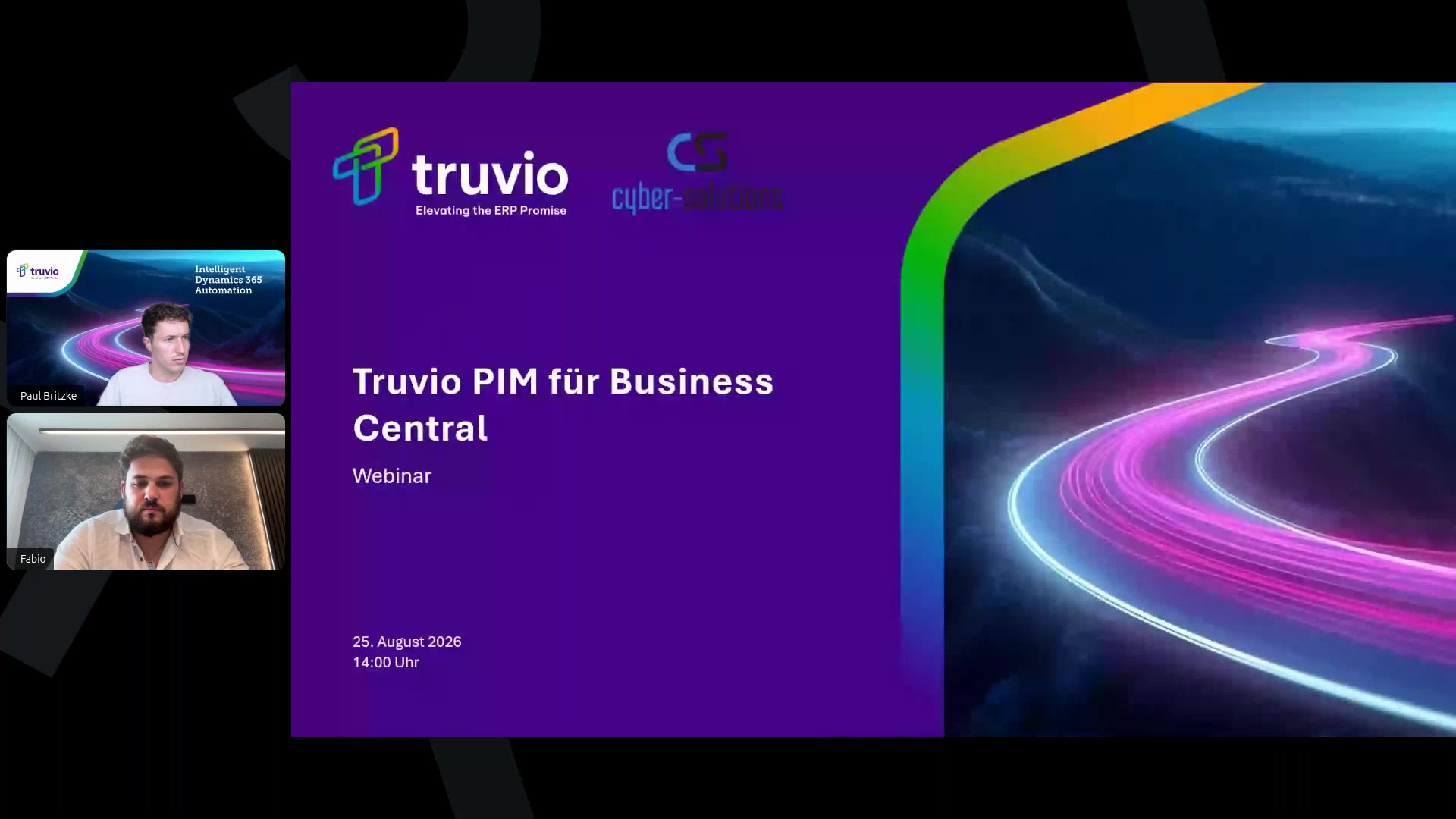
Recap of the joint webinar with Truvio – for everyone who missed it
- Andreas Fritz
- 03.09.2026
- Webbasierte Software
Product data is scattered across systems in many B2B companies, difficult to maintain, and inconsistent across channels. Those using Microsoft Dynamics 365 Business Central know the limitation: the ERP's item master data is designed for accounting and logistics, not for rich, multilingual product information.
That was exactly the topic of our joint webinar with Truvio. This article summarizes the key insights – for those who could not attend live and as a compact review for the participants.
Table of Contents
TLDR
- Business Central is built for operations, not for complex product data – here the item master data concept reaches its limits.
- Truvio PIM builds natively on Business Central and extends the ERP with structured product information instead of adding another external system alongside.
- The Business Central connector, workflows for structured data maintenance, the dashboard for an overview of the product data inventory – and the PIM itself in detail – were demonstrated live.
- A PIM is worthwhile as soon as many products, variants, languages, or sales channels are involved.
- There is no recording of the live session – but Truvio provides an English-language on-demand webinar about PIM for Business Central.
What the webinar was about
The starting point of the webinar was an observation shared by many Business Central users: The ERP reliably manages items but quickly reaches its limits with rich product information. Attributes, variants, relationships between products, multilingual descriptions, and media can only be mapped with difficulty or not cleanly at all using the classic item cards.
The result is scattered data sources, manual rework, and inconsistent product information across website, shop, marketplaces, and catalogs. The webinar showed how this gap can be closed without leaving the familiar Business Central environment. The session was led by Paul Britzke from Truvio – not with slide theory but with a live demo directly in the system.
Key insights
The demo led from the Business Central connector through the maintenance workflows to the dashboard. Four points stood out:
- 1. The connection to Business Central is the core. The BC connector links ERP and PIM directly: The item master data from Business Central forms the basis, enrichment happens in the PIM. No double data maintenance, no separate external system that must be operated in parallel.
- 2. Workflows bring structure to data maintenance. Instead of maintenance on demand, workflows define who supplements and releases which product data in which order. This distributes the work cleanly across roles and makes enrichment traceable – a noticeable difference especially with many products and multiple participants.
- 3. The dashboard makes the data status visible. At a glance, it shows how complete the product data inventory is and where attributes, media, or translations are missing. Data quality becomes measurable and controllable – instead of gut feeling.
- 4. The PIM itself: enrichment without overloading the ERP. Attributes, variants, relationships, media, and languages are maintained in a structured way – in the familiar environment, with shared security, roles, and interface. From there, a consistent product master flows to shop, marketplaces, and catalogs.
Who Truvio PIM in Business Central is suitable for
A PIM becomes relevant where product data is scattered across multiple systems, difficult to maintain, or inconsistent across channels. The step is especially worthwhile for companies with many products, numerous variants, multiple languages, or different sales channels – that is, for a large part of product-centered B2B trade.
The advantage of Truvio’s native approach is that no additional, separate platform needs to be operated. For companies already using Business Central as a central system, this means shorter paths for introduction and operation and a familiar working environment for users.
Conclusion and on-demand webinar
Business Central is strong in the operational core – for rich product data, it needs an extension. A native PIM like Truvio closes exactly this gap without leaving the familiar environment.
There is no recording of the live session. Those who want to catch up on the content: Truvio offers an English-language on-demand webinar about PIM for Business Central – PIM for Business Central | On-Demand Webinar (EN).
Business Central excels at core operational tasks—but it needs a complement for rich product data. A native PIM like Truvio fills exactly this gap without requiring you to leave the familiar environment. There is no recording of the live session. If you’d like to catch up on the content, Truvio offers an on-demand webinar in English on PIM for Business Central.
Frequently Asked Questions - FAQ
Business Central is designed for operational processes; the item cards are optimized for accounting and logistics. A PIM complements the ERP with structured, rich product information – attributes, variants, relationships, media, and translations – that go beyond the standard functions.
No. Truvio PIM is natively integrated into Business Central and behaves like an extension, not as a separate external system. It uses the existing security, roles, and interface, which facilitates implementation and user acceptance.
As soon as many products, variants, languages or sales channels are involved and maintenance via the product master data becomes too complex or error-prone. Then a PIM ensures a consistent product master across all channels.
There is no recording of the live session itself. However, Truvio provides an English-language on-demand webinar on PIM for Business Central: PIM for Business Central (EN).
Create your digital project with us!
We are here to support you in building or enhancing your digital projects. Get in touch with us and find out how we can help bring your vision to life!