In practice, companies face the challenge of meaningfully connecting a wide variety of tools and data silos. The MCP server creates a seamless, standardized bridge here. The result: faster processes, fewer system gaps, less effort for IT, and more scope for action for specialist departments.
A KI agent can, for example, access internal ticket systems, CRM data, accounting platforms, or knowledge databases directly via the MCP server. This not only increases efficiency but also the quality of responses – because current, relevant data is available in the right context. At the same time, the risk of misinterpretations or so-called hallucinations by the AI is significantly reduced. The integration is modularly expandable: a system connected once can easily be used for further use cases. Your existing IT infrastructure remains intact – and is extended by a powerful AI layer.
What is an MCP server?
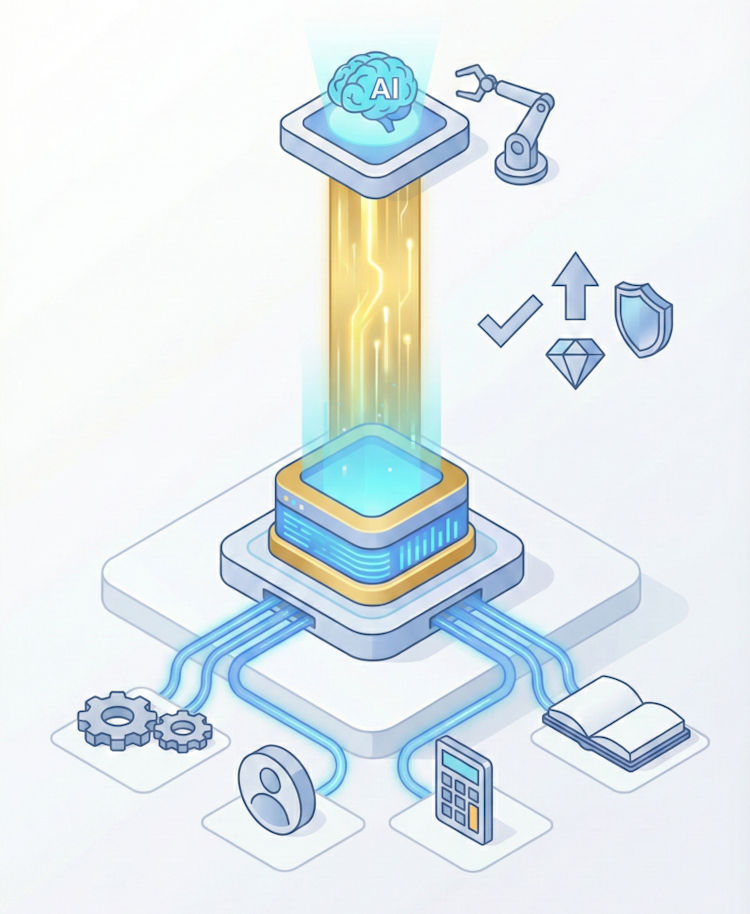
MCP stands for Model Context Protocol, an open standard developed by Anthropic in 2024. An MCP server implements this standard and creates a unified interface between AI applications (such as chatbots or agents) and enterprise systems – including CRM platforms, ERP software, accounting tools, or internal knowledge databases. The MCP server is often described as the “USB-C for AI”: it enables a wide variety of systems to be flexibly, securely, and standardized connected to an AI model. This way, information and processes can reach where they are needed – regardless of the complexity of your IT landscape.
Unlike traditional integrations that require extensive API programming or specialized system knowledge, MCP allows interaction through natural language. Users formulate their requests directly with an AI chatbot of their choice (e.g., Chat GPT, Claude, Copilot, etc.) – the MCP server takes care of the rest. This makes AI-powered automation accessible to business departments without burdening IT teams. At the same time, the integration effort is massively reduced: instead of individual interfaces for each system combination, a single connection suffices – saving time and simplifying maintenance.
Why an MCP server makes sense for companies
Advantages of an MCP server for companies
In many companies, there are numerous tools and databases that often operate side by side but are poorly integrated. This is where the MCP server comes in, connecting the previously isolated silos – with tangible benefits for your business:
Efficiency gains
AI assistants automatically retrieve the necessary information from connected systems, eliminating the need for employees to manually gather data.
Scalability
Once an MCP integration has been set up, it can easily be reused for new use cases. The same connection that serves one purpose today can be used for ten more tomorrow.
Data Sovereignty & Security
With an MCP server, you retain full control over your data flows. You decide who has access to what, and sensitive company data remains protected.
Standardization
All parties involved speak a “common language.” The standardized MCP protocol saves time and effort and ensures compatibility between systems.
Higher-Quality Responses
Thanks to MCP, the AI model always has access to up-to-date, context-relevant data.
Future-proofing
MCP is rapidly establishing itself as the new standard for AI integrations. More and more major providers are supporting the Model Context Protocol or offering their own MCP modules.
How does an MCP server work?
The MCP server acts as a smart real-time mediator between AI and the connected systems. When an AI application makes a request – for example, "Show me all open invoices from the last 30 days" – the MCP server analyzes the context, determines the appropriate target system, retrieves the relevant data, and returns it to the AI. For users, it appears as if the AI itself possesses internal company knowledge – in fact, the MCP server orchestrates all processes in the background. <br><br> Technically, MCP is based on a standardized protocol (often JSON-RPC over HTTP). Communication is bidirectional, secure, and governed by context-dependent authorization logic. At the same time, all data flows are logged transparently. Modern implementations allow for near real-time interaction, enabling AI-powered applications to operate responsively and reliably. Especially in Austria, where data protection and GDPR compliance play a central role, MCP offers a high level of control and security.
We are your partner!
Cyber-Solutions is your technically proficient digitalization partner for fully integrated web portals, e-commerce platforms, and marketing technologies. Our roots lie in custom software development, which gives us the experience and expertise to design outstanding digital solutions and implement them “in-house”.
All our employees possess excellent technical know-how and are characterized by reliability, flexibility, and an efficient way of working.


Head of Business Development
Do you have any questions?
Do you want to advance the digitalization of your company? Are you looking for a specialist to implement a software solution, or are you currently exploring promising ideas and options? We are here to support you with advice and assistance!
Frequently Asked Questions - FAQ
An MCP server is a technical component that structurally connects AI systems with internal data, APIs, and functions, enabling controlled access to corporate information.
MCP servers are used to securely connect AI applications such as chatbots, assistants, or automations with existing systems and data sources.
An MCP server enables controlled data access, clear interfaces, better traceability of AI interactions, and a clean separation between AI logic and enterprise systems.
Among others, CMS, ERP, PIM, CRM systems, databases as well as individual APIs and services can be connected.
Defined access concepts, roles, logging, and clear interfaces ensure that AI systems only access authorized data and functions.
Yes, MCP servers are modular and can be extended with additional data sources, functions, or AI use cases.
Cyber-Solutions takes over the conception, implementation, integration into existing system landscapes as well as the ongoing further development of MCP server solutions.