PIM in B2B Commerce: Data Standards, Sequence, Effort
- Andreas Fritz
- 05.06.2026
- Digitalisierung
In the technical wholesale, electrical industry, and building materials trade, the question is no longer "Do we need a PIM?", but rather "How do we implement it so that it works?" Those who already have the basic knowledge often stumble in practice over other issues: supplier data in three dozen formats, the question of whether the PIM or the shop comes first, and the honest assessment of how much staff the company ultimately commits.
This article addresses exactly that. It does not explain for the umpteenth time what a PIM is, but answers the questions that really arise in B2B trade before and during a PIM implementation – from Datanorm, BMEcat, and ETIM to the correct sequence and economic efficiency.
Table of Contents
- TLDR
- Briefly Explained: What a PIM Is – and How It Differs from ERP
- Data Standards in B2B Trade: Datanorm, BMEcat, ETIM
- Practical Example: B2B Wholesale with Many Suppliers
- Who Works with PIM – and How Much Effort Is Realistic
- PIM or Webshop Relaunch – Which Comes First?
- What Can Realistically Be Said About Profitability
- How Cyber-Solutions Supports PIM Implementations
- Conclusion: With PIM, Preparation Matters More Than the Tool
TLDR
- In B2B trade, the natively supported data standards (Datanorm, BMEcat, ETIM) are often economically more decisive than any frontend feature of a PIM.
- Without a PIM, multiple employees manually maintain supplier data between Excel, ERP, shop, and catalog – errors are then system-related, not due to carelessness.
- Those considering a PIM and webshop relaunch in parallel should clarify the data foundation first – a relaunch on poor data reproduces old problems in a new look.
- The personnel effort does not disappear with a PIM; it shifts – away from data copying towards data quality and supplier onboarding. Reliable FTE figures only emerge after an actual analysis.
- Flat-rate ROI promises are a reliable warning sign. Serious estimates require an inventory of your own data flows.
- Basics, definitions, and distinctions from ERP, DAM, MDM, and PDM are clarified in the article “What is a PIM?” – this article picks up one step later.
Briefly classified: What a PIM is – and how it differs from ERP
To ensure the rest of the article builds cleanly, here is the distinction in two sentences: A PIM (Product Information Management) is the central data basis for everything a company communicates externally about a product – descriptions, translations, classifications, variants, media links – prepared for webshop, marketplace, print catalog, and app. The ERP remains the commercial truth (item number, price, stock); the PIM complements it exactly where the ERP is not designed: with free, multilingual, marketing-relevant content.
Those who want to read the complete definition, functionality, and distinction from DAM, MDM, and PDM can find it in the foundational article “What is a PIM?”. For B2B trade, the decisive insight is another – and it starts with the data formats.
Data standards in B2B trade: Datanorm, BMEcat, ETIM
In certain industries, it is practically impossible to do without a PIM. The technical wholesale trade, the electrical industry, the building materials trade, and related B2B fields rely on structured data exchange formats that ERP alone cannot represent:
- Datanorm has been the established standard for article master data exchange in technical wholesale for decades. Usually delivered by the manufacturer, processed further by the dealer.
- BMEcat is the catalog format for e-procurement and electronic marketplaces. Often a prerequisite for supplying OCI or procurement portals like SAP Ariba or Onventis.
- ETIM is the international classification for technical products, supplemented by features, units, and value lists. Without ETIM conformity, a product simply falls out of the filter in many B2B marketplaces.
A PIM that is taken seriously in these industries must not only export these formats but also import, validate, and keep them consistent across versions. This is exactly where the economically relevant effects arise: a Datanorm delivery that is manually remapped into an ERP today flows into a PIM in a structured manner, is matched against the internal classification model, and automatically prepared for shop and marketplace. When choosing tools, the question “Which data formats can the PIM natively handle?” is often more decisive than any frontend feature.
Practical example: B2B wholesale with many suppliers
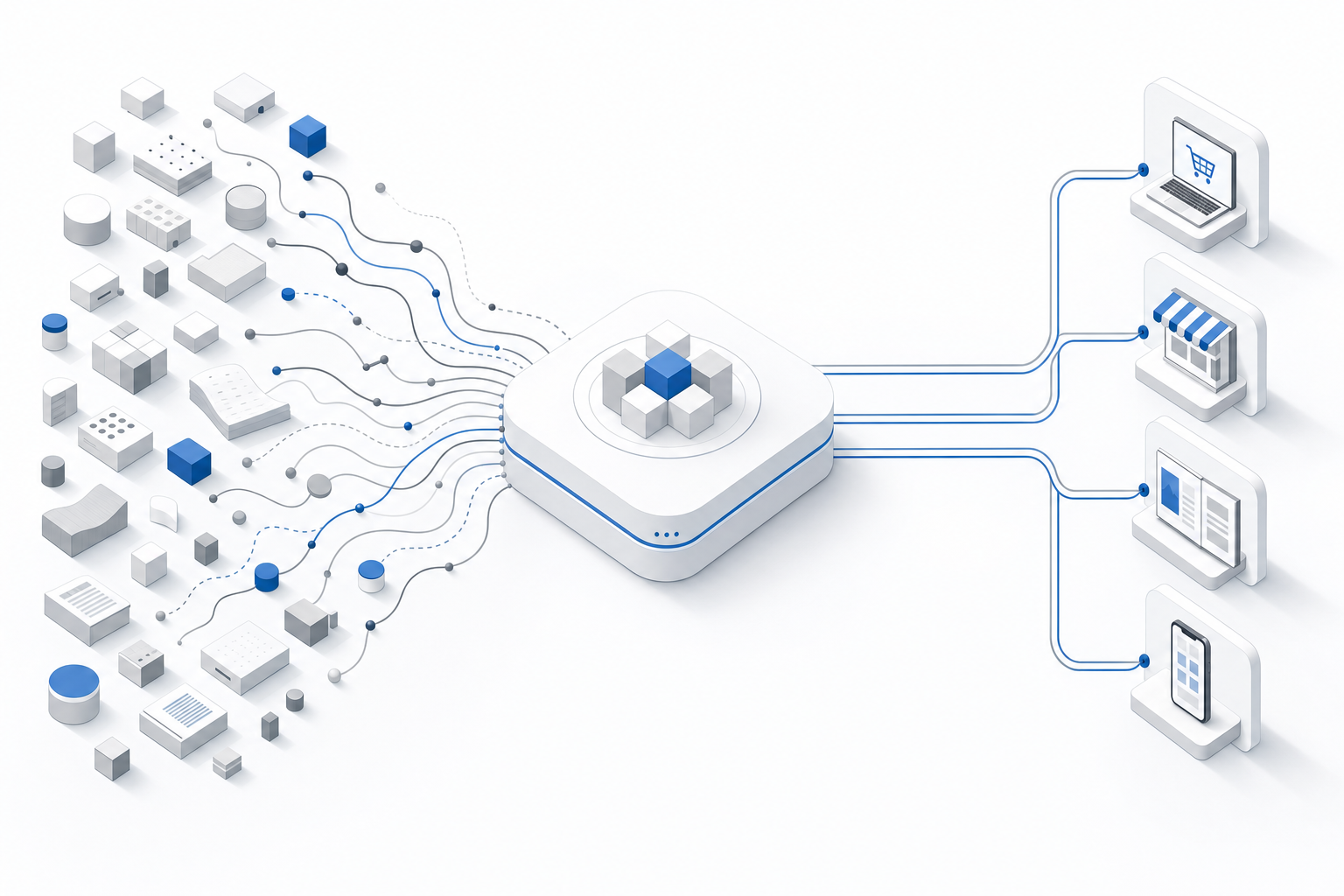
Representing a typical setup: a medium-sized wholesaler sells tens of thousands of articles, of which a smaller part is actively managed. Data comes from a high double-digit to triple-digit number of suppliers in varying quality – some as Datanorm deliveries, some as Excel lists with inconsistent units of measure, some as PDF catalogs. Sales require a functioning webshop, a procurement portal for large customers, and a classic print assortment for field sales.
Without a PIM, the honest answer is usually: several employees maintain Excel tables, check supplier updates, and copy data between shop, ERP, and catalog. Errors are system-related – not because of sloppy work, but because the tool does not fit the problem. With a PIM, the focus shifts: supplier data flows in structured, ETIM classifications are assigned via rules, translations and marketing descriptions are centrally maintained and automatically distributed to channels. The personnel effort does not disappear – it shifts away from repetitive data copying towards data quality and supplier onboarding.
Who works with the PIM – and how much effort is realistic
A PIM is typically a cross-functional system. In daily operations, product managers, marketing and content teams, e-commerce managers, translators or translation agencies, and sales departments typically work with the system. IT is responsible for integrations with ERP, shop, DAM, and marketplaces. Data maintenance responsibility usually lies with the specialist department, not IT. This is exactly where it is decided whether a PIM implementation succeeds: those who view the PIM purely technically and exclude organizational aspects end up with a second Excel with a better interface. Those who consider workflows, responsibilities, and approval processes actually build a productive data platform.
How much personnel effort is ultimately needed cannot be answered generally. In practice, five factors drive FTE demand most strongly: the number of actively managed articles and the frequency of new products; the number of suppliers and the heterogeneity of their data deliveries; the number of channels, languages, and markets; the depth of classification (ETIM complete versus proprietary); and the share of automatable maintenance processes. Those starting with a PIM and simultaneously inheriting poorly maintained supplier data initially build up effort rather than reduce it – data quality is a prerequisite, not a side effect. Reliable FTE figures only emerge after an actual analysis of your own data flows.
PIM or webshop relaunch – which first?
A question that often comes up in initial discussions: do we need a PIM, a new shop system – or both? The honest answer depends on the bottleneck. Those who have a functioning shop but are slowed down by poor product data (incomplete descriptions, wrong variants, missing images, no clean classifications) solve more problems with a PIM project than with a shop relaunch. Those who operate an outdated shop platform whose data is basically okay get the greater leverage with a relaunch.
In many medium-sized projects, however, the double solution proves economically sensible: PIM and shop are set up simultaneously but developed strictly in this order – first the data foundation, then the channel. A shop relaunch on a poor data foundation reproduces old problems in a new look. Conversely, a PIM only unfolds its value when the channel also uses the structured data. In any case, it is worthwhile to think of the architecture decoupled from the start: PIM, shop, and ERP as independent systems with clear interfaces, not as a monolithic platform where everything is married together.
What can realistically be said about economic efficiency
Amortization of a PIM project is often cited in pitches with catchy figures – “pays off after 18 months”, “saves 30% maintenance effort”. Such statements are rarely wrong but almost always context-dependent: they apply to a specific setup that does not have to be your own. Flat-rate ROI promises are a reliable warning sign in PIM projects.
What can be said seriously: economic benefit arises in three categories. First, in effort – less manual data copying between Excel, ERP, shop, and print templates; noticeable as soon as more than two channels and a few thousand articles are involved. Second, in time-to-market – new products, promotions, and assortment changes reach the channel faster; relevant wherever the assortment changes frequently or is subject to seasonal fluctuations. Third, in data quality – fewer returns due to incorrect descriptions, lower risk of warnings due to missing mandatory information, higher conversion through complete product data; hard to quantify but consistent feedback from our projects.
Those seeking a reliable ROI estimate cannot avoid an actual analysis of their own data flows. A well-founded discussion of typical cost structures is provided in the article “What does a PIM system cost?” – concrete amortization times can only be named reliably after a brief inventory, not in a blog.
How Cyber-Solutions supports PIM implementations
In PIM projects, the biggest challenge is rarely the software – but the connection to the rest of the system landscape. Cyber-Solutions supports PIM implementations with a focus on holistic architecture: ERP connection, DAM integration (including CELUM), CMS and e-commerce linkage, as well as the professional modeling of the product structure. As a Truvio partner, Cyber-Solutions often implements PIM in the context of an integrated CMS/commerce/PIM platform that remains economically calculable for medium-sized manufacturers and dealers – other constellations are also possible depending on the starting situation.
Those still unsure whether a PIM fits the current maturity level will find a practical guide in the article “When does a PIM make sense?” and a well-founded discussion of cost structures in the article “What does a PIM system cost?”.
Conclusion: In PIM, the groundwork decides, not the tool
In B2B trade, PIM projects rarely fail because of the software. They fail due to unclear data ownership, supplier data that no one has structured, and the wrong sequence. Those who clarify the data standards, responsibilities, and the question “PIM or relaunch first?” before the project start have already completed the economically relevant part – the rest is craftsmanship.
Are you planning a PIM or evaluating alternatives? Let’s clarify together which costs are realistic – technically and organizationally.
Frequently Asked Questions - FAQ
It depends on the bottleneck. If product data is the limiting factor – incomplete descriptions, missing classifications, incorrect variants – a PIM project brings more benefit than a shop relaunch. If the data is fine but the shop technology is outdated, the opposite applies. Often, both make sense simultaneously, but in this order: first define the PIM data foundation, then build the shop on top of it.
Serious answers only after an inventory. General amortization promises always apply to a specific external setup. The benefit arises in three areas – reduced maintenance effort, shorter time-to-market, and higher data quality – and becomes noticeable faster the more channels, articles, and suppliers are involved.
Create your digital project with us!
We are here to support you in building or enhancing your digital projects. Get in touch with us and find out how we can help bring your vision to life!