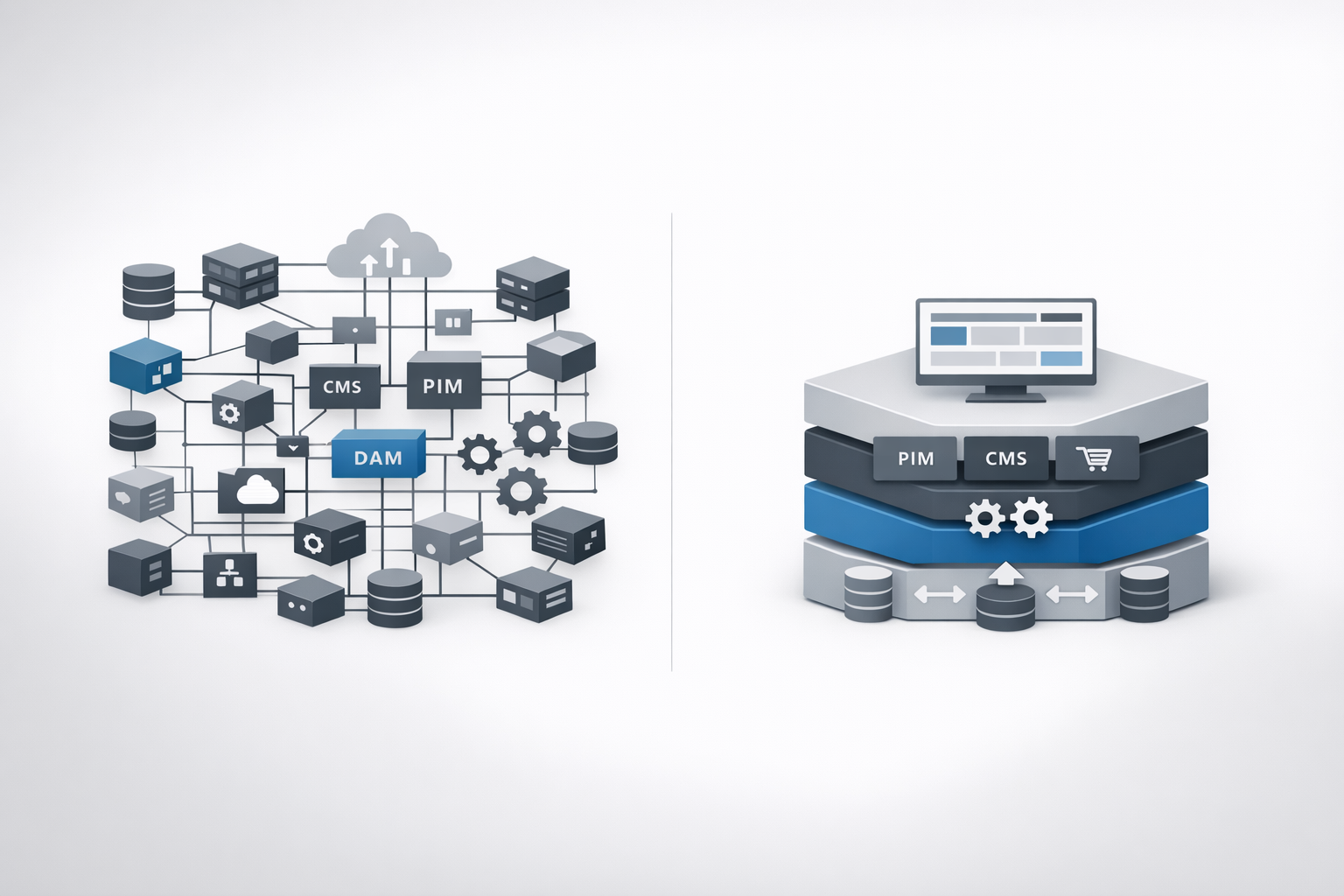
Looking for a Pimcore alternative? Why Truvio PIM is the better choice for many companies
- Andreas Fritz
- 15.05.2026
- Digitalisierung
Anyone looking for a Pimcore alternative today is rarely seeking fewer features – but rather more focus, clarity, and feasibility. A platform that meets enterprise requirements without becoming a permanent construction site. This is exactly where Truvio PIM comes into play.
Table of Contents
- TLDR
- Why companies look for Pimcore alternatives
- Pimcore: strengths – and typical challenges
- Truvio PIM: integrated platform instead of modular system
- Pimcore vs. Truvio PIM in direct comparison
- Scenarios where Truvio PIM is particularly suitable
- Pimcore vs Truvio PIM in direct comparison
- Conclusion: Not the most powerful, but the most suitable platform wins
TLDR
- Pimcore is extremely flexible but often complex and development-intensive.
- Truvio PIM pursues an integrated, pragmatic platform approach for CMS, PIM, and Commerce.
- Whether SAP Business One, Microsoft Dynamics 365, Odoo, APplus, proALPHA, or Sage: Truvio PIM is especially well suited for B2B companies that want to bring their ERP data into a seamless digital platform.
- Especially for B2B companies with ERP integration (e.g., Microsoft Dynamics), Truvio PIM is very well suited.
- Less customization, clearer processes, and lower operational effort speak in favor of Truvio PIM.
- The “better” solution depends less on the range of functions and more on the organizational reality.
Why companies look for Pimcore alternatives
Pimcore is undoubtedly a very powerful Digital Experience Platform. It covers PIM, DAM, CMS, MDM, and commerce-related scenarios and offers enormous freedom in modeling and extension. However, this openness often leads to challenges in practice.
Many companies find after implementation that they operate a system that permanently ties up high development resources. Adjustments, updates, performance optimizations, and editorial processes are rarely “out of the box” solutions but the result of individual implementations. This is legitimate – but not sensible for every company.
The desire for a Pimcore alternative often arises not from dissatisfaction with the functions but from the need for less complexity, faster implementation, and better maintainability with comparable business benefits.
Pimcore: strengths – and typical challenges
The great strength of Pimcore lies in its flexibility. Complex data models, individual workflows, and highly customized architectures can be excellently mapped. For organizations with strong in-house teams and clear technical governance, this can be a real advantage.
However, many projects show a different picture: high initial effort, long project durations, and a Backend that is only limitedly intuitive for business departments. In addition, many central functions – such as workflows, quality assurance, or enterprise features – only become meaningfully usable in commercial editions or through additional development. The supposed open-source advantage quickly relativizes.
Thus, Pimcore is less an “off-the-shelf” product and more a framework that must be managed very consciously.
Truvio PIM: integrated platform instead of modular system
Truvio PIM pursues a different approach. Instead of maximum openness, the platform relies on integrated, clearly structured modules for CMS, PIM, commerce, and marketing that are coordinated from the start.
The focus is on real business processes: maintaining product data, publishing content, adopting prices from the ERP, delivering customer-specific assortments, and processing orders cleanly. All this is part of the platform – without each project starting from scratch.
Truvio PIM is particularly strongly positioned in the B2B environment, among other things through deep standard integrations in Microsoft Dynamics 365 and a clear focus on complex pricing logics, customer-specific catalogs, and self-service portals. In addition to the deep standard integration in Microsoft Dynamics 365, Truvio PIM can also be connected via open interfaces to other common ERP systems such as APplus, proALPHA, Sage, Odoo, or SAP Business One.
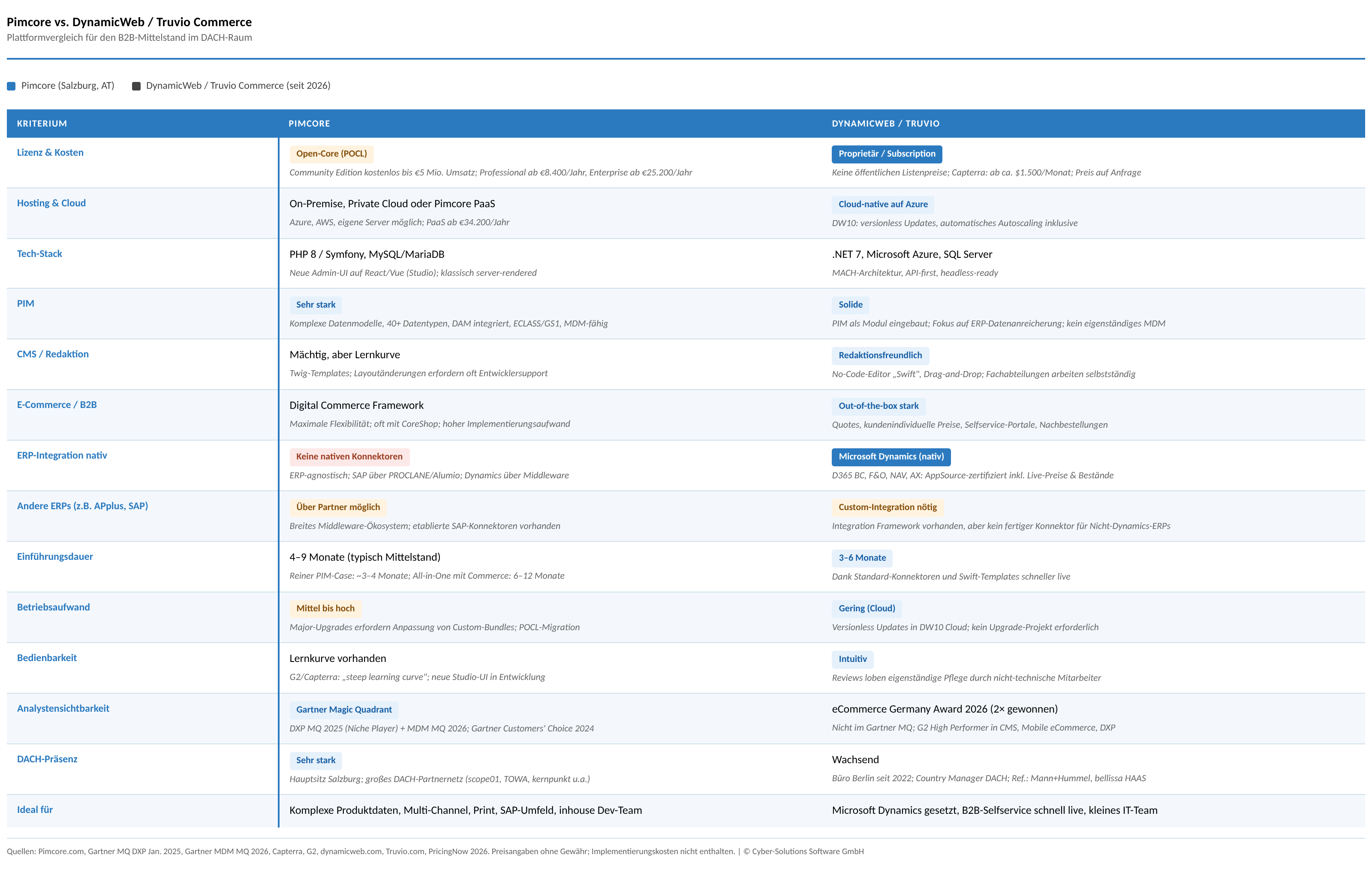
Pimcore vs. Truvio PIM in direct comparison
In direct comparison, two fundamentally different philosophies emerge. Pimcore is ideal when maximum individuality is required and corresponding development resources are available. Truvio PIM, on the other hand, scores where standardization, time-to-market, and operational reliability are paramount.
Truvio PIM significantly reduces the customization share because many typical requirements are already provided. This lowers project risks, simplifies updates, and makes the platform better maintainable in the long term. Editorial teams also benefit from clear structures and consistent user guidance.
Scenarios for which Truvio PIM is particularly suitable
Truvio PIM is especially suitable for companies that want to operate CMS, PIM, and commerce not as isolated individual solutions but as a seamless digital platform. Especially in the B2B context with ERP-driven processes, Truvio PIM plays to its strengths.
Typical scenarios are medium-sized to larger organizations looking for a stable, extendable solution without having to permanently bind a large development team. Here, Truvio PIM convinces with a balanced mix of customizability and clear guardrails.
Pimcore vs Truvio PIM in direct comparison
Conclusion: Not the most powerful, but the most suitable platform wins
The question “Pimcore or Truvio PIM?” cannot be answered universally. What matters is not which system can theoretically do more, but which one practically fits the company, the processes, and the available resources better.
For many companies currently looking for a Pimcore alternative, Truvio PIM is a very convincing option: less complexity, faster results, and a platform approach that noticeably eases everyday operations.
Are you currently evaluating Pimcore alternatives or facing a re-platforming decision?
Frequently Asked Questions - FAQ
For many scenarios, yes. Especially when CMS, PIM, and Commerce are considered in an integrated way, Truvio PIM covers typical enterprise requirements very well.
When extremely individual data models, exceptional processes, or a very high degree of customization are necessary and corresponding development resources are available.
Both platforms are scalable. Truvio PIM relies more heavily on standardized cloud and update mechanisms, which simplifies operation.
No, but companies with Microsoft Dynamics ERP benefit particularly strongly from the existing integrations.
Create your digital project with us!
We are here to support you in building or enhancing your digital projects. Get in touch with us and find out how we can help bring your vision to life!