Headless, Composable or classic CMS?
- Andreas Fritz
- 15.07.2026
- Digitalisierung
Few discussions in digital projects are as ideologically charged as the one about CMS architecture. Headless was long considered synonymous with modernity, classic systems as outdated - and composable as the next big thing. In 2026, many projects show a more sober picture: the architecture question is not a matter of belief but a matter of requirements. Those who answer it incorrectly pay in both directions - either with a platform that hits its limits at the first new channel, or with an architecture whose complexity no one in the company needs.
This article is deliberately not a plea for any one model. It provides the criteria with which IT managers, CTOs, and digital leaders can make a well-founded decision for their enterprise website - regardless of whether it ends up being Umbraco, Sitecore, Storyblok, or a hybrid solution.
Table of Contents
- TLDR
- Three architecture models at a glance
- Why the architecture question will be different in 2026
- When headless and composable really bring advantages
- When headless is overkill
- Six criteria for the decision
- Hybrid: the pragmatic path for many enterprise websites
- How Cyber-Solutions supports companies in architecture decisions
- Conclusion: Architecture follows requirements, not trends
TLDR
- The choice between classic, Headless, and Composable approaches in 2026 is not a technology question but a requirements question – and not a matter of "modern or outdated".
- Headless and Composable are especially worthwhile when there are multiple output channels, multiple frontends, and a deep integration landscape (PIM, DAM, ERP, CRM).
- For a single website with a small editorial team, Headless is often overkill: higher operational complexity, more infrastructure, noticeable friction in daily editorial work.
- Modern platforms like Umbraco, Sitecore XM Cloud, Xperience by Kentico, or Storyblok are hybrid-capable – starting coupled and delivering headless where it brings benefits is a realistic path.
- Six criteria drive the decision: channels, editorial reality, team and operations, integrations, TCO over the lifecycle, migration capability.
Three architecture models at a glance
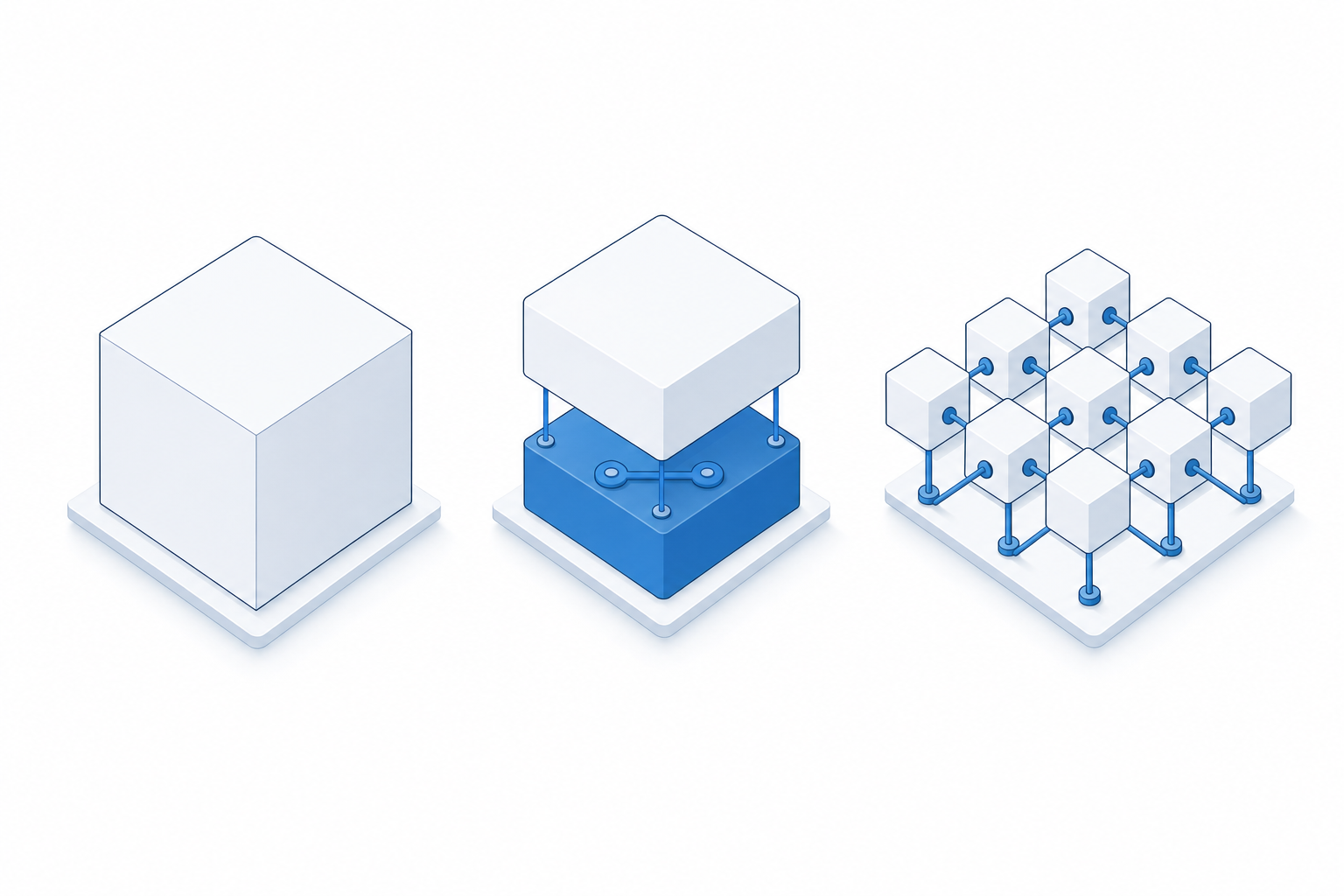
In the classic, coupled CMS, content management and delivery are in one system: the CMS renders the website itself, editors work with direct preview and publish without detours. One system, one deployment, one operational model – this is the great strength of this approach and the reason why it still works well for many corporate websites.
Headless separates these layers: the CMS manages content and provides it via APIs, the frontend – for example, a React or Next.js application – is developed, deployed, and operated separately. Content can thus be delivered to any number of channels: website, app, self-service portal, digital signage, or AI-powered assistants.
Composable goes one step further. Instead of one platform that does everything, specialized building blocks – CMS, PIM, DAM, Search, Commerce – are orchestrated via APIs into an overall architecture. The principle behind this is known as MACH architecture (Microservices, API-first, Cloud-native, Headless) and promises maximum flexibility in choosing the best individual components.
Important for 2026: the boundaries between these models are blurring. Umbraco delivers content headlessly via the Content Delivery API without giving up coupled rendering. Sitecore positions XM Cloud as a hybrid platform. Storyblok is designed API-first but offers editors with the Visual Editor a working experience otherwise only known from coupled systems. The architecture decision is therefore no longer a product decision – almost every relevant platform can serve multiple models.
Why the architecture question is different in 2026
A few years ago, the Headless question was often staged as a directional decision between future and past. That phase is over. Many organizations now have practical experience with decoupled architectures – and thus a more realistic picture of costs: own frontend codebase, own build and deployment pipelines, preview infrastructure, additional coordination between teams. The hype has given way to consolidation, where companies look more closely at which setup fits their requirements.
At the same time, new requirements have emerged that speak for structured, API-capable content: AI-supported workflows in content, delivery of content to assistant systems, and the growing number of digital touchpoints make it attractive to treat content as cleanly modeled data rather than pages. However, the decisive factor is less the rendering model than the quality of the content model – presentation-independent structured content can also be provided via APIs from a coupled CMS.
The architecture question in 2026 is therefore no longer "Headless: yes or no?" but: Which channels do we serve today and realistically in three years, who works daily with the system, and which systems in our landscape need to consume content?
When Headless and Composable bring real advantages
Decoupled architectures play to their strengths where content actually has more than one consumer. Those who operate, alongside the website, an app, a customer portal, trade show displays, or multiple country and brand presences from a common content hub benefit directly from API-first delivery: content is maintained once and used multiple times without copy-and-paste between systems.
The organization of the development team is also a valid argument. When frontend and backend teams work separately, have different release cycles, or multiple service providers deliver in parallel, decoupling reduces dependencies: the frontend can be deployed independently, technology decisions in the frontend are not tied to the CMS, and individual parts of the platform can be exchanged without touching the overall system.
The third typical driver is the integration landscape. In companies where product data from PIM, assets from DAM, and transaction data from ERP flow into digital experiences, a composable architecture is often the realistic description of the current state. Here, an API-oriented setup creates order: clear responsibilities per system, defined interfaces, and the possibility to further develop individual building blocks without risking a big bang. Overall, these advantages translate into shorter time-to-market with parallel workflows, better reusability, and an architecture that grows with new channels.
When Headless is overkill
The counter calculation is less often made – and this is exactly where many costly wrong decisions arise. Those who operate a single corporate website with a manageable editorial team buy a second system world with Headless: a separate frontend with its own hosting, own builds, and own monitoring, often plus a preview solution that replicates what coupled systems can do out of the box. Each of these layers must be operated, secured, and maintained – over the entire lifecycle of the platform.
This becomes especially noticeable in daily editorial work. Marketing teams that build landing pages independently, arrange content visually, and want to reliably see how a page looks before release quickly encounter friction in poorly tailored Headless setups: layout changes require developer tickets, the preview is incomplete, and the promised freedom ends up exclusively with the development team. Many projects show that exactly this editorial autonomy determines satisfaction with the platform – not the elegance of the architecture.
The economic picture also shifts. The total cost of ownership of a decoupled solution includes, besides license or subscription costs, the initial frontend development, ongoing operation of two systems, and coordination effort between more participants. If there is no multi-channel benefit, the company finances complexity without value.
Six criteria for the decision
- Channels and delivery: Which touchpoints do you serve today – and which are realistically planned in the next three years? A roadmap with app, portal, or multiple brands argues for decoupling; a single website does not.
- Editorial reality: Who maintains content, how often, with what autonomy? The more marketing should design independently, the more important are visual editing and reliable preview – native or as a deliberately planned building block.
- Team and operations: Is there internal frontend competence and DevOps maturity for operating additional systems? A decoupled architecture without the appropriate operational model quickly becomes a permanent construction site.
- Integration landscape: How many systems deliver or consume content – PIM, DAM, ERP, CRM, search? The more participants, the more valuable clear API interfaces are.
- TCO over the lifecycle: Calculate licenses, implementation, operation, and further development over several years – not just the implementation budget. Two system worlds cost permanently more than one.
- Migration capability: Can the architecture grow with changing requirements? A clean, presentation-independent content model is the best insurance here – regardless of the chosen model.
Those who answer these six questions honestly have usually already made the architecture decision – and can justify it internally comprehensibly.
Hybrid: the pragmatic path for many enterprise websites
Between "all coupled" and "all decoupled" lies the path many enterprise projects actually take in 2026: hybrid architectures. The corporate website is rendered classically – with full editorial autonomy, preview, and fast publishing workflows – while the same content is additionally delivered via a delivery API to app, portal, or partner systems. Platforms like Umbraco or Xperience by Kentico support exactly this pattern without the company having to commit on day one.
The strategic advantage lies in investment protection: the architecture follows actual needs instead of a future bet. If a new channel is added, the API foundation is available; if it remains with the website, no unnecessary complexity has been built up. The prerequisite is a content model that is structured and presentation-independent from the start – here it is decided whether the platform remains flexible later or not.
Hybrid is therefore not a compromise solution but for many companies the architecturally most honest answer: as much decoupling as necessary, as little operational complexity as possible.
How Cyber-Solutions supports companies in architecture decisions
As an implementation partner for Umbraco (Platinum Partner), Sitecore (Silver Partner), Storyblok (Certified Partner), and Kentico (Bronze Partner), we have no interest in selling a specific architecture model – we implement all. This makes a neutral evaluation possible: in architecture workshops, we analyze the six decision criteria together with IT and marketing, evaluate realistic target images including TCO consideration, and give a well-founded recommendation – whether coupled, headless, composable, or hybrid.
With over 15 years of experience in enterprise web projects on .NET and Azure basis as well as integrations of ERP, PIM, and DAM systems, we accompany the decision through to implementation – and ensure that the content model is built from the start so that the architecture can grow later.
Conclusion: architecture follows requirements, not trends
Neither is Headless per se modern, nor is a classic CMS per se outdated. The viable decision arises from an honest analysis of channels, editorial reality, team, integrations, and costs – and from a platform choice that keeps hybrid paths open. Those who treat architecture as a requirements question instead of a matter of belief build platforms in 2026 that work in everyday life and remain future-proof.
Are you facing a relaunch or architecture decision for your enterprise website?
Frequently Asked Questions - FAQ
Yes – future-proofing depends less on the rendering model and more on the platform roadmap and a structured content model. Modern decoupled systems like Umbraco or Xperience by Kentico offer APIs through which content can additionally be delivered headless at any time. It only becomes critical with platforms that lack active development.
Headless describes the decoupling of content backend and frontend within a CMS. Composable is an architectural principle at a higher level: several specialized services – CMS, PIM, DAM, Search, Commerce – are combined via APIs into an overall solution. A composable setup usually uses a headless CMS but goes significantly beyond that.
In addition to the CMS, operation and maintenance of the separate frontend are required: hosting, build and deployment pipelines, monitoring, as well as often a dedicated preview infrastructure. There is also coordination effort among more participants. These items should be considered in every TCO assessment over the entire lifecycle.
With platforms featuring integrated delivery APIs, this is a realistic path – provided the content model was structured and presentation-independent from the start. Those who model content as pure pages with embedded layout make the later transition unnecessarily difficult.
Basically yes, but rarely in full scale. For many medium-sized organizations, a pragmatic approach is more sensible: a hybrid-capable CMS platform plus targeted best-of-breed components where they deliver real added value – for example, a PIM for complex product data. The crucial point is that the team and operations can sustainably manage the chosen complexity.
Create your digital project with us!
We are here to support you in building or enhancing your digital projects. Get in touch with us and find out how we can help bring your vision to life!