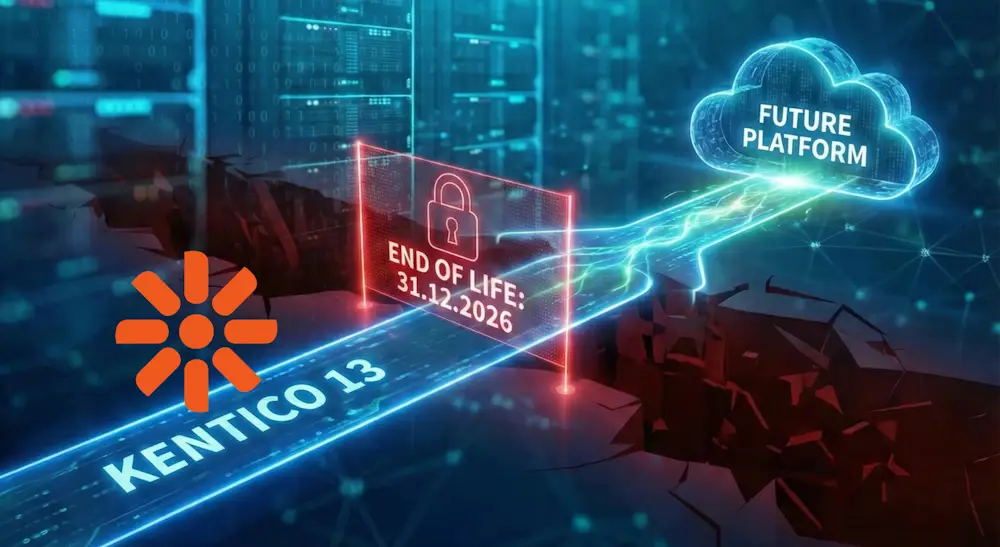
Kentico 13 replacement: 2026 is the last year with security support
- Andreas Fritz
- 19.01.2026
- Websites
Kentico Xperience 13 is in the final phase of its product life cycle. According to the official support lifecycle, 2026 is the last year in which Kentico 13 will receive security updates. Support will end completely on January 1, 2027, including security-related patches. For productive systems, this represents a clear technological turning point that should be addressed at an early stage.
Even though Kentico 13 will continue to run technically after support ends, real risks arise from this point on. Newly discovered security vulnerabilities will no longer be fixed, and dependencies on .NET versions, frameworks, or server infrastructures will continue to evolve without the CMS responding. Especially in more complex setups with authentication, forms, integrations, or customer-specific extensions, the attack surface will continue to grow.
From a technical perspective, continuing to operate a CMS without active manufacturer support is becoming increasingly difficult to justify. Security concepts, internal audits, and external requirements now necessitate regular updates and a traceable patch strategy. With the end of security support, this foundation is completely eliminated. In addition, maintenance costs increase because errors or incompatibilities must be resolved internally without the ability to resort to official fixes.
In addition to security, technological development also plays a central role. Kentico 13 is based on an architecture that no longer corresponds to the current state of the art in modern CMS and DXP systems. Topics such as API-first approaches, flexible content models, headless scenarios, or the structured provision of content for AI-based systems can only be implemented to a limited extent or with considerable individual effort. At the same time, search engines and generative AI models are evolving toward clearly structured, high-performance, and semantically clean content.
This makes the replacement of Kentico 13 relevant from an SEO and GEO perspective as well. Technical fundamentals such as loading times, clean markup structures, flexible URL concepts, and consistent metadata are crucial for classic search engines as well as for generative systems that analyze, summarize, and recommend content. A CMS that is no longer being developed increasingly limits these possibilities.

Possible migration path
The year 2026 should therefore not be seen as simply the “last year of security,” but rather as a transition phase for planning and implementing a replacement. A Kentico migration is not a short-term update, but rather a structured project. Content, templates, integrations, and SEO-relevant aspects must be thoroughly analyzed and transferred to a modern target architecture. Those who wait until shortly before the end of support to react risk time pressure, technical compromises, and unnecessary dependencies.
Planning for replacement early on reduces risks, creates technological flexibility, and ensures that digital platforms remain secure, maintainable, and expandable even after 2026. For companies with Kentico 13 installations, now is the right time to strategically prepare for replacement rather than waiting to react once support has already expired.
Create your digital project with us!
We are here to support you in building or enhancing your digital projects. Get in touch with us and find out how we can help bring your vision to life!