Why the crucial question is not which AI feature you use, but in what context
- Andreas Fritz
- 12.08.2026
- Digitalisierung
Few topics are currently as high on the agenda for digital decision-makers as the use of AI in content creation. Most discussions revolve around tools: which model, which plugin, which feature. The more difficult and important question is asked less often – namely, within what framework AI is allowed to access corporate content at all.
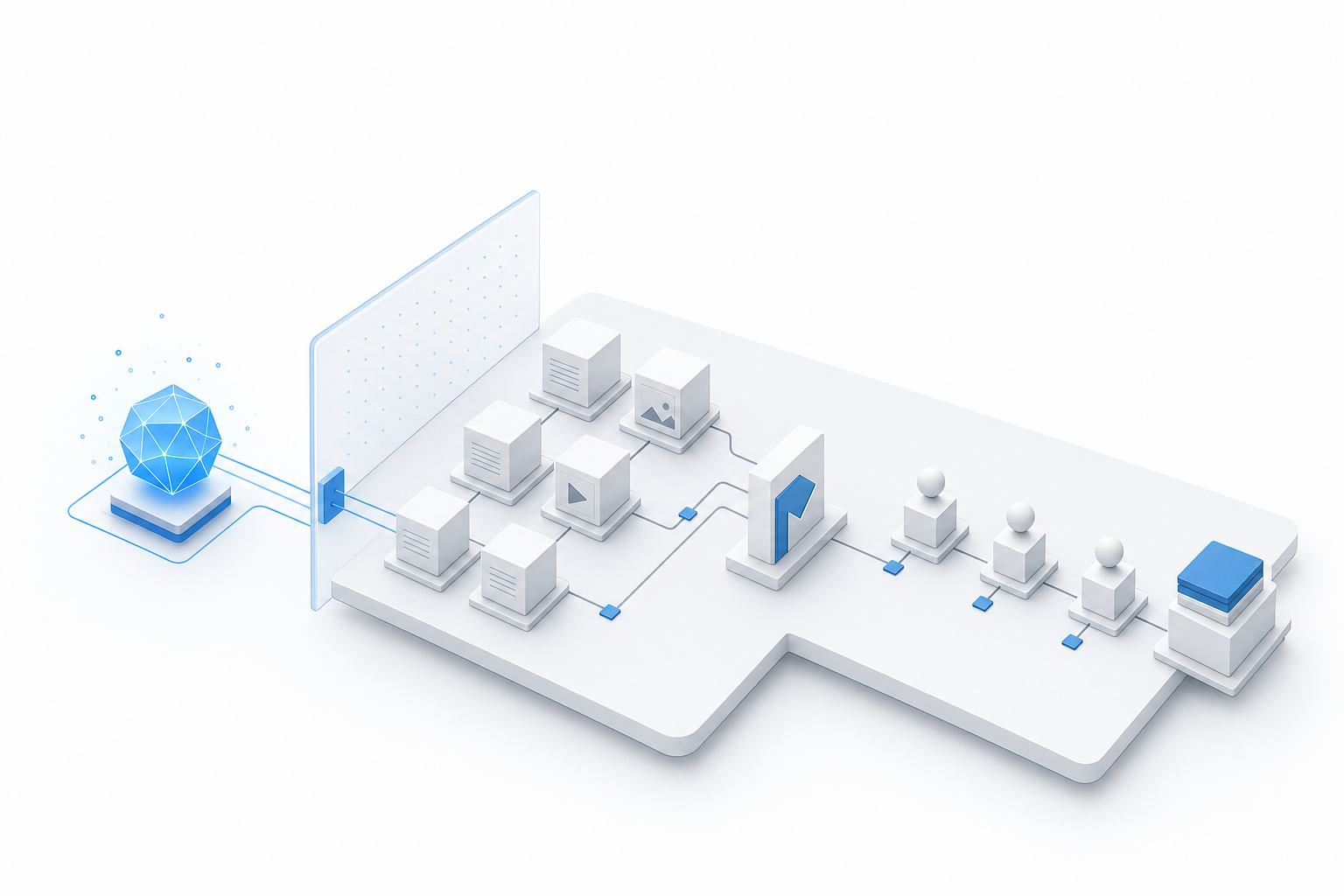
Those who want to integrate AI permanently and responsibly into editorial and content workflows do not first decide on features, but on control: where data flows, who is allowed to trigger which action, and at which point a human retains approval. That is exactly what this article is about.
Table of Contents
- TLDR
- The right order: first the framework, then the tool
- Where control tips in the AI-supported content workflow
- Data protection and data flows as the first governance question
- Roles, rights and the human in approval
- How Cyber-Solutions brings controlled AI into existing platforms
- Conclusion: AI maturity means keeping control
TLDR
- The decisive AI question in CMS is not “which tool”, but “within which framework”.
- Control fails where AI generates unchecked content, accesses systems, or shares data externally.
- Data protection begins with the question of where content flows and whether it can end up in foreign training data.
- A clean role and rights concept and a human in the approval process are prerequisites, not shortcuts.
- Governance is not a brake block but the condition that allows AI to be used productively at all.
The right order: first the framework, then the tool
The appeal of AI in CMS is obvious: texts are created faster, translations almost on the side, metadata and summaries at the push of a button. Accordingly, the temptation is great to simply activate the next available feature and get started. In practice, however, it regularly turns out that exactly this order leads to problems – not because the tools are bad, but because no one has defined the framework in which they are allowed to work.
A viable AI deployment in the enterprise environment therefore begins with a strategic decision, not a technical one. Before choosing a model or integration, questions arise such as: Which content may AI process, and which explicitly not? Where does real added value arise, and where does the risk outweigh it? And who in the company is responsible for approving AI-generated content? Only when these guardrails are in place does the tool question become meaningfully answerable.
This order sounds obvious but is often reversed in everyday life. This article deliberately argues from the governance side – because controlled AI is not a feature you buy, but a framework you set.
Where control fails in the AI-supported content workflow
Control is rarely lost due to a single major mistake. It erodes gradually at several typical points. The first is uncontrolled content generation: when AI publishes texts directly and without a review step, editorial responsibility shifts unnoticed from the human to the model. Errors, outdated statements, or an inappropriate tone only become apparent once the content is already public.
The second point concerns system access. Modern AI approaches are no longer limited to text suggestions but can – for example via interfaces and protocols like MCP – actively create content, change product data, or adjust configurations. This is powerful and sensible as long as it is clearly defined which actions are allowed. Without these boundaries, a helpful assistant quickly becomes an incalculable risk.
The third, often underestimated point is data leakage. As soon as content is sent to an external model for processing, it potentially leaves one’s own control. Those who do not know where this data flows and how it is reused give up part of their information sovereignty – sometimes without realizing it.
Data protection and data flows as the first governance question
Before functions are discussed, it should be clarified which path content takes through the system. For companies in the DACH region, this is not only a technical but also a legal question: the GDPR and internal compliance requirements demand traceability about which data is processed where. An AI deployment that cannot provide this traceability is hardly viable in the enterprise context.
Central to this is the question of whether corporate content can end up in foreign training data. Serious providers and architectures clearly separate the use of a model from its training and ensure that submitted content is not used to further develop the model. Those who do not have this assurance should not process sensitive content at all.
Practically, this means consciously designing data flows: which content remains in controlled environments, which may go to external models, and how this transition is secured. A well-thought-out setup makes these boundaries not only one-time but permanent and verifiably visible – for example through logging, clearly defined interfaces, and a conscious selection of the models used.
Roles, rights, and the human in approval
Control over AI is ultimately always a question of roles and rights. An enterprise CMS already provides the crucial foundation here: role-based access control, graduated permissions, and approval workflows. These proven mechanisms must also be consistently applied to AI functions. It makes a difference whether every person in the back office may trigger AI actions with far-reaching effects or whether such functions are tied to defined roles.
Equally important is the human in approval. AI can excellently assist – research, structure, deliver drafts – but editorial responsibility should remain clearly with a human. This principle, often called “human in the loop”, ensures that quality, factual accuracy, and brand consistency are maintained. It does not significantly slow the process but prevents costly errors that occur when unchecked content goes live.
For companies, this concretely means: AI functions are not activated “for everyone” across the board but embedded in the existing role and rights concept. This way, it remains traceable who may perform which AI action – and control stays where it belongs.
How Cyber-Solutions brings controlled AI into existing platforms
As an Umbraco Platinum Partner and Anthropic Registered Partner, Cyber-Solutions supports companies in introducing AI not as an isolated experiment but as a controlled part of their existing platform. The starting point is never the tool alone but the framework: which content, which roles, which data flows – and only then the appropriate technical implementation.
At the tool level, concrete building blocks are available that fit exactly into this governance framework. A Model-Context-Protocol Server (MCP) creates a standardized, controlled interface between AI applications and enterprise systems, where you define which actions are allowed and where data flows. The AI Essentials Toolkit for Umbraco, in turn, brings central AI functions preconfigured and embedded in the existing CMS architecture instead of running them uncoordinated side by side. Both are deliberately designed so that control remains with the company.
The decisive factor is the order: Cyber-Solutions first defines the framework together with you and then selects the technology that fits – not the other way around.
Conclusion: AI maturity means keeping control
Mature AI use in CMS is not shown by the speed at which new features are activated but by the clarity of the framework in which they operate. Those who first clarify data flows, roles, and approvals can use AI productively without giving up control – and that is exactly the difference between an experiment and a viable solution.
Do you want to bring AI into your content workflows without losing control over data and approvals?
Frequently Asked Questions - FAQ
No. What matters is not whether a model runs in the cloud, but under what conditions. Reputable providers contractually guarantee that submitted content is not used for training. More important than the pure cloud question is that data flows are consciously designed and sensitive content is specifically excluded.
By selecting providers and architectures, clearly separating usage and training, and establishing clear internal rules about which content may be processed at all. A controlled interface and the deliberate separation of sensitive data ensure that nothing goes unnoticed to the outside.
A major one. An enterprise CMS already includes roles, permissions, and approval workflows – the foundation of any AI governance. When AI functions are consistently integrated into these existing mechanisms instead of being operated separately, control over actions and content is maintained.
As soon as AI regularly accesses real company content. The effort for a viable concept is manageable and can be aligned with the size of the editorial team. It pays off at the moment when the first unchecked content would otherwise have gone live.
Create your digital project with us!
We are here to support you in building or enhancing your digital projects. Get in touch with us and find out how we can help bring your vision to life!