What does a PIM system cost – and what do the costs really depend on?
- Andreas Fritz
- 15.04.2026
- Digitalisierung
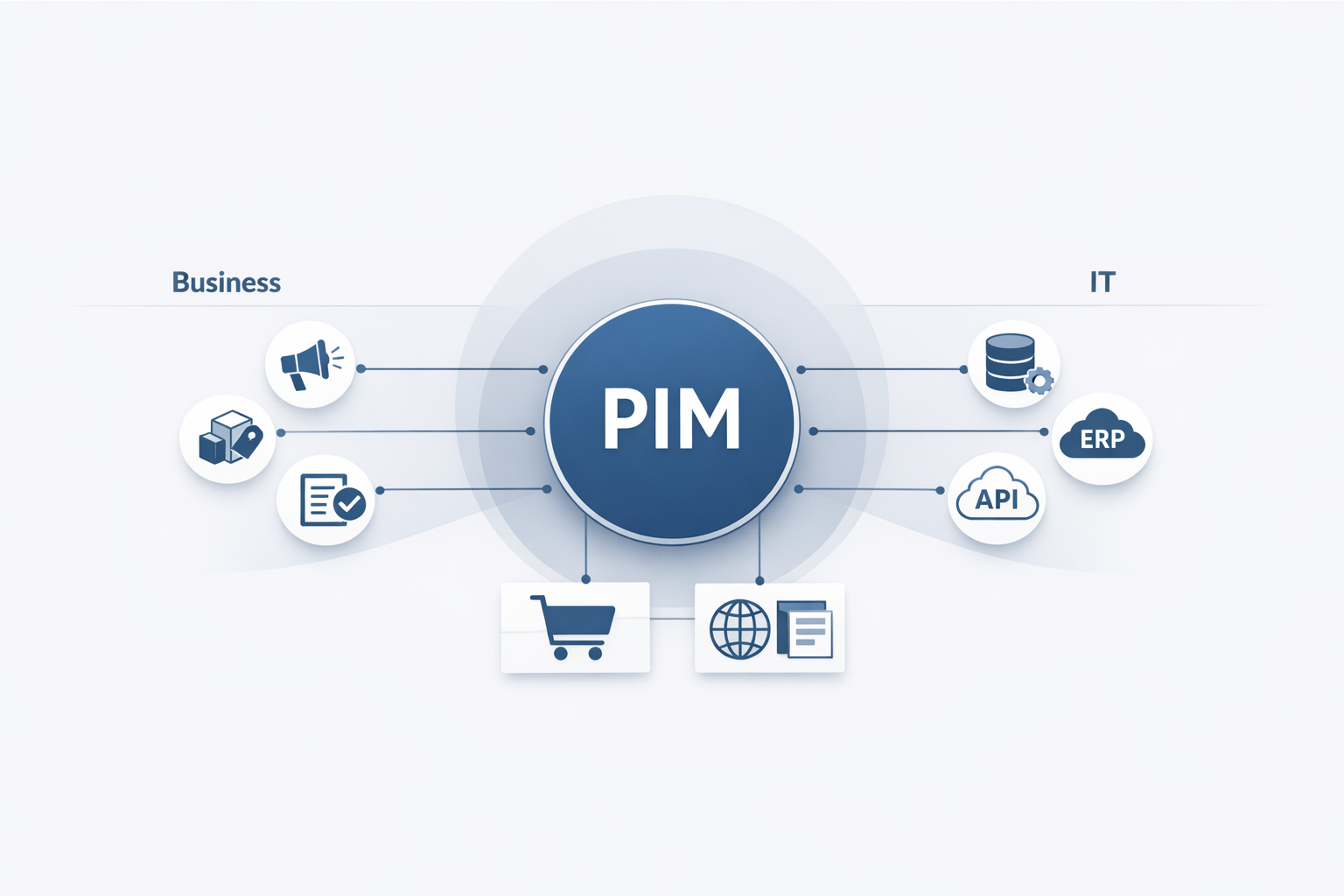
"How much does a PIM cost?" is almost always the first question – and almost never the right one. Because a PIM system is not isolated software, but a central platform that connects product data, processes, and systems. Accordingly, costs arise not only from licenses but especially from data structures, integrations, and organizational maturity.
This article shows how PIM costs realistically add up, why simple price comparisons are misleading – and what decision-makers should pay attention to when they need a reliable budget and decision-making basis.
Table of Contents
- TLDR
- Why the question “What does a PIM cost?” falls short
- The three real cost blocks of a PIM system
- License costs: necessary but rarely decisive
- Introduction costs: where business and IT decide together
- Ongoing costs: operation, governance, and further development
- When a PIM becomes expensive – and when it saves costs
- Conclusion: evaluating costs instead of comparing prices
TLDR
- The license is rarely the biggest cost factor – data, processes, and integrations are decisive.
- PIM costs arise throughout the entire lifecycle: implementation, operation, further development.
- Business and IT decisions jointly influence the costs, not separately.
- A PIM pays off not through the price, but through scalability, data quality, and time-to-market.
Why the question “What does a PIM cost?” falls short
In many projects, the cost question is reduced to the license. This is understandable but dangerous. A PIM deeply affects existing system landscapes, changes workflows, and redefines how product data is created, maintained, and used within the company.
Therefore, PIM projects differ not primarily by software price but by their organizational and technical starting point. Two companies with the same tool can have completely different total costs – depending on how structured data, processes, and responsibilities are.
The three real cost blocks of a PIM system
Realistically, PIM costs consist of three areas: license, implementation, and ongoing operation. Early discussions usually only address the first – although the other two have a much stronger long-term impact.
Especially for decision-makers, it is important to understand: A PIM is not a one-time project but a permanent platform that grows with assortment, channels, and markets.
License costs: necessary but rarely decisive
License costs vary greatly. SaaS PIMs are often billed based on users, supplemented by limits for SKUs, storage, or channels. Simple setups start in the double-digit euro range per user and month, enterprise solutions can cost several thousand euros monthly.
For decision-making, however, the absolute price is less relevant than what the system can deliver in the long term: data model flexibility, integration capability, workflow support, and scalability. A cheap tool that hits limits after two years quickly becomes expensive.
Implementation costs: where business and IT decide together
Implementation is usually the largest cost block – and the one companies can influence most. Efforts arise for data modeling, migration, interfaces, workflows, training, and change management.
Crucially: These costs are not purely an IT issue. Business units determine how complex product structures are, which content is maintained, and how many variants, channels, and languages must be supported. IT decides on architecture, integrations, and operation. The clearer goals, data responsibility, and processes are defined, the more controllable the effort remains. Unclear requirements and “we’ll look later” decisions are the most common cost drivers.
Ongoing costs: operation, governance, and further development
After go-live, the project ends – but not the costs. Operation, support, updates, new channels, new markets, and organizational changes are part of everyday life. Internal efforts also add up: Who is responsible for data quality? How are changes managed? How are new requirements prioritized? A PIM without governance causes more costs in the long run than it saves.
When a PIM becomes expensive – and when it saves costs
A PIM becomes expensive when it is introduced as a tool without considering the organization. This leads to media breaks, parallel maintenance, and frustration. A PIM saves costs when understood as a central data platform: less manual work, faster product launches, consistent data across all channels, and better scalability with growth.
Conclusion: Evaluate costs instead of comparing prices
The real question is not: “What does a PIM cost?”
But: What costs arise today due to missing structure, manual maintenance, and limited scalability? A PIM is an investment in clean data architecture and efficient processes. Those who understand this make better decisions – regardless of the chosen system.
Are you planning a PIM or evaluating alternatives? Let’s clarify together which costs are realistic – technically and organizationally.
Frequently Asked Questions - FAQ
As soon as multiple channels, many products, or frequent changes are involved – often earlier than expected.
For the license, yes; for the overall effort, not necessarily. Implementation and operation must be considered.
Unclear data responsibility, missing governance, and subsequent process changes.
Initial effects often appear quickly, the full benefit unfolds with increasing use.
Let's clarify together which costs are realistic – technically and organizationally.
Create your digital project with us!
We are here to support you in building or enhancing your digital projects. Get in touch with us and find out how we can help bring your vision to life!