When does a PIM really make sense? A practical guide for SMEs
- Andreas Fritz
- 03.04.2026
- Digitalisierung
The question "When does a PIM make sense?" arises in almost every digitization project. Especially SME manufacturers and retailers face the challenge of efficiently managing growing product data, serving new sales channels, and at the same time not overloading internal processes. Agencies and partners are also looking for solutions that are functional on the one hand but not unnecessarily complex and expensive on the other.
In practice, the right time for a PIM can be determined very clearly. This article shows why Excel and ERP eventually become insufficient, what risks arise without a PIM, and why Truvio PIM is a sensible, integrated, and economical solution especially for SMEs.
Table of Contents
Why product data has become a bottleneck today
In recent years, the role of product data has changed significantly. Customers expect complete, accurate, and appealing information – whether they are browsing a webshop, marketplaces, or printed materials. At the same time, internal requirements are increasing: variants, technical specifications, media, prices, availability, and translations must be maintained consistently.
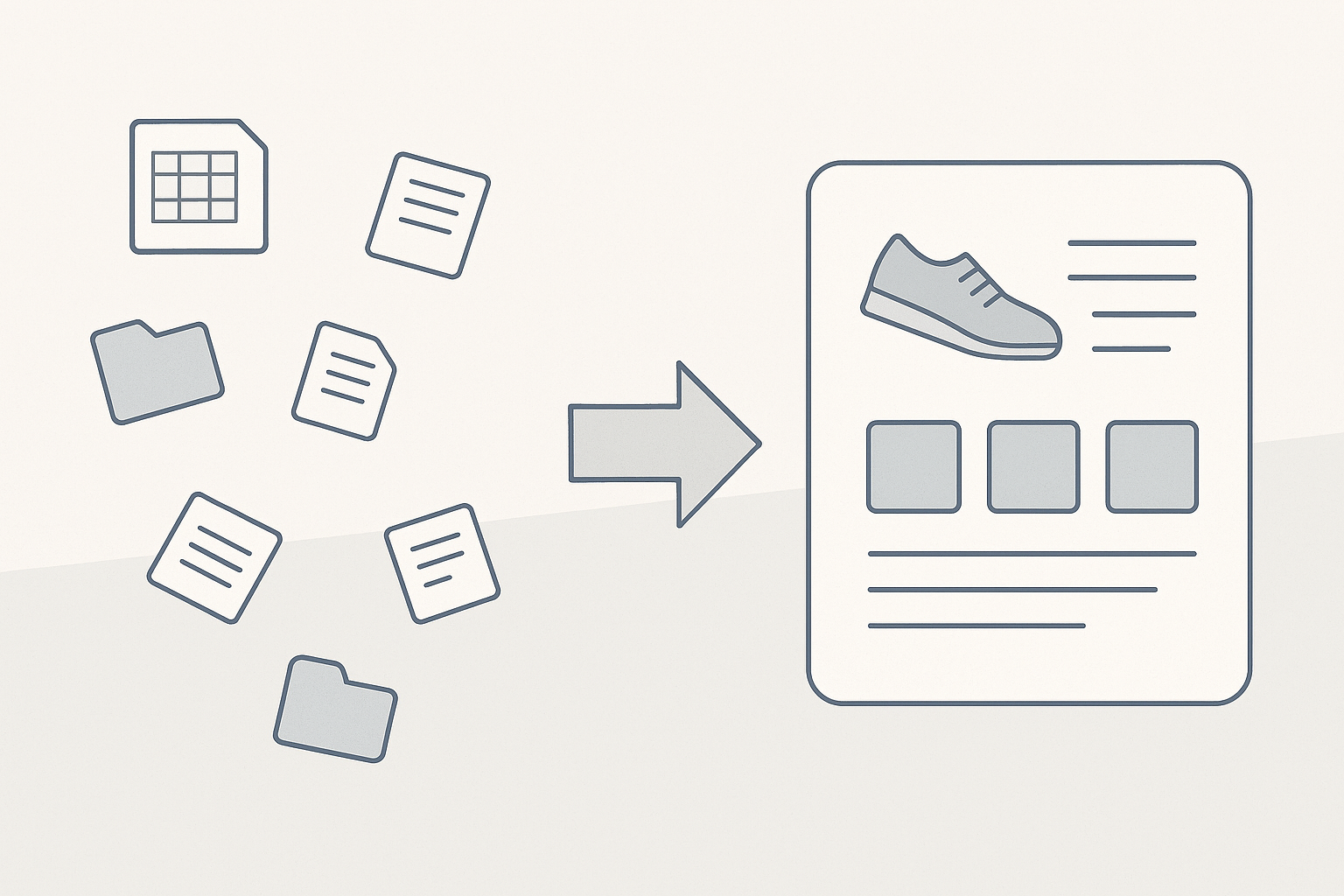
Without a structured system, this quickly leads to friction losses. A typical situation is when product data exists but is spread across multiple departments and in different formats. This causes sources of errors, long coordination paths, and delayed publications. A PIM creates clarity and central responsibility here.
Where Excel and ERP systems reach their limits
Many SMEs start their product data journey in the ERP and supplement it with Excel or shared folders. This is understandable but only viable up to a certain point. ERP systems are not designed for freely structured product information. Excel, on the other hand, is great for lists but unsuitable for versioned, media-neutral product data and processes.
The limits usually appear in four areas: variant management becomes confusing, translations cannot be controlled, media is scattered, and business processes depend on individual people who know "the Excel master file." Errors in the webshop or on marketplaces become the rule rather than the exception.
When a PIM becomes economically sensible
The right time for a PIM can be clearly defined as soon as certain warning signs appear. These include growing product portfolios, increasing numbers of sales channels, or the desire for marketing automation. As soon as more than one channel must be supplied with consistent data – webshop, print, marketplaces – the effort without a PIM increases exponentially. Internal factors also play a role: manual processes cost employees valuable time and increase the risk of errors. A PIM usually pays off sooner than many think – often already from 300–500 products or a few hundred variants.
Why Truvio PIM is a pragmatic solution for SMEs
Truvio PIM pursues an approach that differs from many classic PIM systems. Instead of a complex, standalone platform, Truvio PIM relies on a tightly integrated combination of CMS, e-commerce, PIM, and marketing functions. This reduces integration effort, data redundancies, and interface risks. For SMEs, this means fewer systems, less complexity, and less ongoing effort.
Moreover, Truvio PIM allows product-centric, editorial-friendly maintenance without major onboarding hurdles. Companies can grow step by step: from a simple product catalog to multichannel distribution with automated data processes.
What agencies particularly appreciate about Truvio PIM
For agencies and implementation partners, Truvio PIM represents an attractive middle ground. It offers the flexibility of a modern data model without the typical complexity of an enterprise PIM. Technically, it is based on a solid .NET architecture, can be cleanly extended, and plays to its strengths through the close connection to CMS and commerce.
Above all, Truvio PIM offers a clear advantage: projects remain economically calculable. Implementations do not take months but are often realizable much faster. This makes the system plannable for agencies and price-attractive for customers.
the right time is measurable – and often earlier than expected
Whether for SMEs or agencies: a PIM always makes sense when product data becomes a bottleneck. Those who want to serve more than one sales channel, manage variants, or expand internationally benefit enormously from a structured product data process. Truvio PIM is a solution that combines technical clarity, economic sense, and pragmatic implementation.
If you would like to check whether your company is already at the point where a PIM delivers real added value, please contact us. We analyze your product data process and show which solution makes economic sense for you.
Frequently Asked Questions - FAQ
A PIM can pay off starting from 300–500 products, especially when variants, media, or translations play a role.
Yes, at least for central data maintenance. Excel remains useful for analyses, but not for product data management.
Yes, but the particular advantage lies with SMEs looking for an integrated system without complex PIM landscapes.
Typically, a PIM implementation takes about 3 to 9 months, depending on company size, data quality, and system landscape, and longer for more complex requirements.
Integration usually takes place via standardized interfaces – data exchange can be clearly structured and cleanly versioned.
Create your digital project with us!
We are here to support you in building or enhancing your digital projects. Get in touch with us and find out how we can help bring your vision to life!