
Digitalization in medium-sized companies: 5 reasons why many fail
- Viktoria Stojanovic
- 10.07.2020
- Digitalisierung
Table of contents
- Why digitalization often fails in medium-sized companies
- Lack of experts: skilled workers are missing in many SMEs
- Lack of focus: too many different pilot projects are launched
- Division of labor: too strict a division of powers blocks new opportunities
- Internal resistance: Why many project managers have problems implementing new innovations
- Investment risk: investments in hardware and software are too high
- Avoidance
- Statistics
- Conclusion
Why digitalization often fails in medium-sized companies
Digitalization is no longer a foreign word. You could even say it is “mega trendy”. Nevertheless, 4 out of 5 companies are not digitized. Many attempts are made, but most of them fail at the most basic things, such as the lack of skilled workers. This article will tell you why this is the case and why small and medium-sized companies in particular are not digitized.

Lack of experts: skilled workers are missing in many SMEs
The problem of a lack of skilled workers also affects this sector. A digital business transformation requires specific skills. Developers, programmers, project managers and product designers are urgently needed.
However, such experts are in short supply in medium-sized companies. Many companies assign digitalization projects to the IT department, which often does not have the capacity for new projects.
One way to counteract this is outsourcing.

Lack of focus: too many different pilot projects are launched
In many small and medium-sized enterprises (SMEs), hundreds of pilot projects are launched in isolation from one another. Four out of five of them are abandoned or end unsuccessfully. As a study by Accentre shows. However, this sobering figure is usually not even known to medium-sized companies. This is because successful lighthouse projects are often marketed aggressively and sold to the supervisory board as a “sensation”. The fact is, however, that for many medium-sized companies, digital projects are like a patchwork rug.
For a good start, you should have a good strategy/plan.

Division of labor: too strict a division of labor blocks new possibilities
The current division of labor in companies is slowing down digitalization. Some attempts to enable digitalization are associated with the invention of new job titles. Examples of this are the Chief Digital Officer (CDO) or the Venture Capital Manager (VCM). However, it is important to remember that a company should only be digitized as a whole and not in part. Many employees have no idea about digital communication options, which makes the whole thing much more difficult.

Internal resistance: why many project managers have problems implementing new innovations
Humans are creatures of habit. They are reluctant to move out of their comfort zone. However, this is exactly what is needed if digitalization projects are to be successful. Resistance is one of the most common phenomena that project managers have to deal with in their daily work.
Many technically skilled project managers are often helpless in the face of this problem and see themselves as unable or only partially able to overcome this resistance, let alone to make it useful in terms of achieving the project goals.

Investment risk: investments in hardware and software are too high
The costs incurred by investing in new technologies and applications deter many medium-sized decision-makers. Compared to large corporations with strong capital resources, the digital transformation in medium-sized companies therefore appears to be extensive and is only being driven forward in a few areas.

Avoidance
There are many digitalization models that show how to best digitize your business. One of many is, for example, the 3 Horizon Model. It consists of three consecutive phases that build on each other. The 3 Horizon Model was first presented in 1999 in “The Alchemy of Growth".
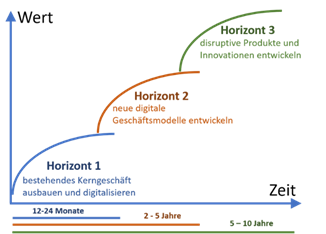
There are thousands of these models. In the end, it doesn't matter which model you choose. The goal is the same. Digitalization.
42
%of companies believe that their competitors, who digitized earlier, are streets ahead of their own company.
Source: www.bitkom.org
Conclusion
Since a large number of companies have not yet gone digital, it is definitely worth investing in a project of this kind. “Digitalization creates more competition, and this competition leads to more innovation,” says Bitkom President Achim Berg.
Create your digital project with us!
We are here to support you in building or enhancing your digital projects. Get in touch with us and find out how we can help bring your vision to life!